
Three Powerful Strategies For Doctors To Crush Their Own Health Goals In 2026
Jan 07, 2026
Shortly after Halloween, I hid my daughter’s candy haul.
Not because candy is evil nor because I’m trying to ban sugar from our house. But because I kept finding candy wrappers in random trash cans, and I realized that having a giant bag of candy sitting out was just too tempting for my family.
We have a similar rule with ice cream. We don’t buy it at the grocery store. If we want ice cream, we go out to the ice cream shop for it.
Why?
Because I know myself and my family. If ice cream is sitting in the freezer, one of us will start digging into it while inadvertently tempting the others. But if we have to leave the house to get it, we’re much more likely to pause and ask, Do we really want this right now?
This isn’t about discipline. It’s about strategy.
As physicians, we’re taught to rely on willpower when it comes to our own health. But if 2026 is the year you want a different relationship with food, weight, and fitness, it may be time to stop trying harder—and start strategically setting yourself up for success.
There are three key principles that matter far more than motivation alone when it comes to making lifestyle changes: situational modification, upgrading your habits, and accountability.
1. Situational Modification: Make the Better Choice the Easier Choice
Psychologist Angela Duckworth uses the term situational modification to describe changing the environment so that you don’t have to constantly fight yourself.
One of her well-known examples involves cell phones in schools. Research shows that even when a phone is face down, silent, and not being used, it still pulls on a student’s attention. Part of the brain is wondering what it might be missing. When schools remove phones entirely by keeping them in lockers from morning bell to final bell—students focus better and learn more.
The same concept applies to health behaviors.
As doctors everywhere we go we’re quietly encouraged to snack on pretzels, indulge in doughnuts in the doctors lounge, and sip more caffeine from a sugary latte. If the only plan is just to power through this environment with self-control, we’re making this a lot harder than it has to be. Situational modification asks a different question: What can I change around me so I make the healthy choice easy to make?
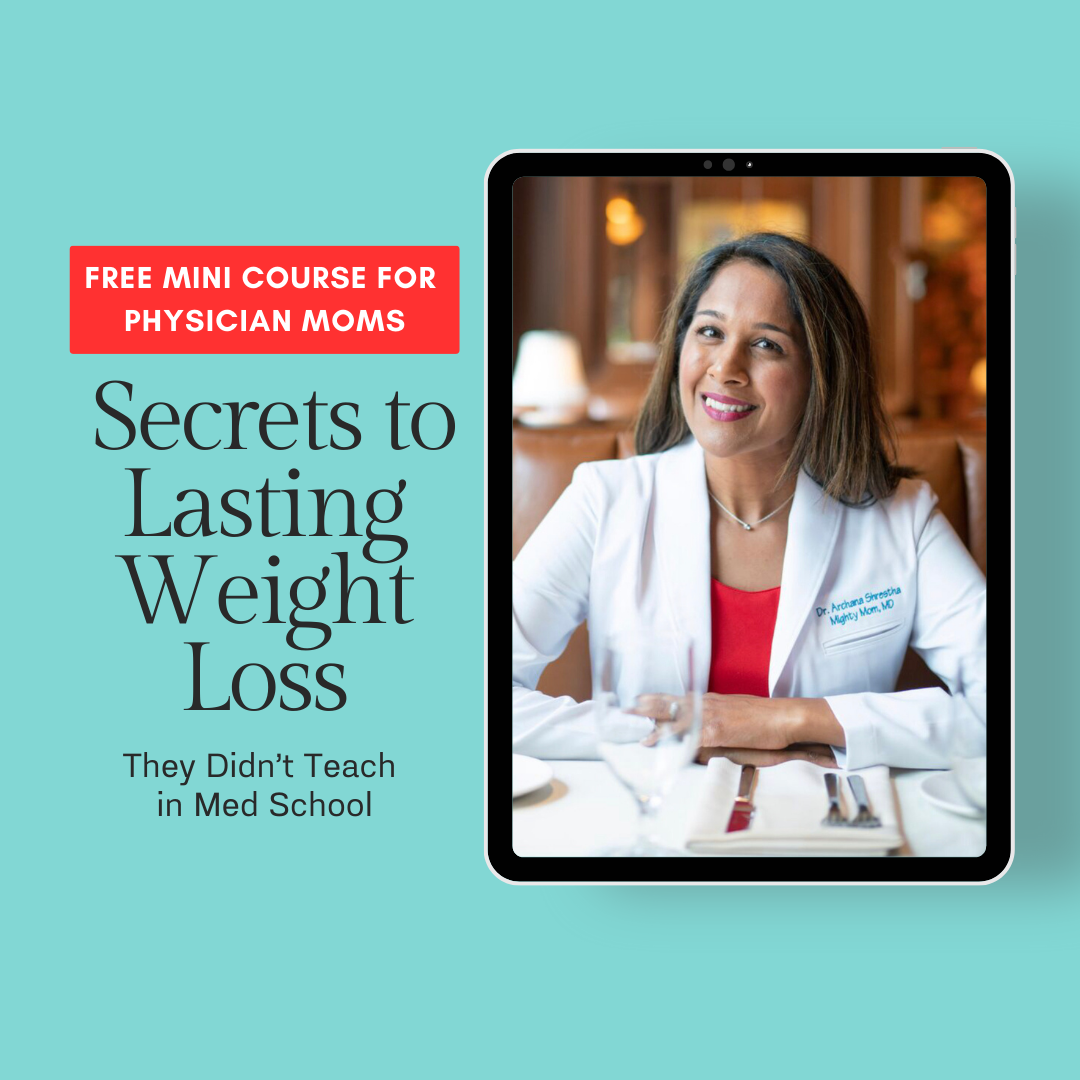
Learn the secrets to lasting weight loss that are helping women physicians lose weight for the last time. Watch the FREE Mini Course here.
At home is often the lowest-hanging fruit. Think freezing the extra chocolate chip banana bread instead of keeping it on the counter. Consider not buying certain foods like cookies, honey roasted nuts or pastries that you know are especially tempting. How about putting snacks you don’t actually want to eat out of sight or on high shelves. None of this is extreme. It’s practical and creates a pause. A moment where you get to decide, rather than mindlessly react.
On the flip side, make the habits you want to do easier. Such as packing protein-filled snacks for lunch or on days you’ll be working late. Keep a bowl of fresh fruit out on the countertop. Put your treadmill or walking pad right in front of the TV so walking while entertaining yourself becomes an easy choice to make.
Work environments are tougher. Hospitals and clinics are full of ultra-processed food, break room candy and catered drug rep lunches. While physician lounges often stock processed grab and go snacks like Rice Crispy treats or Lorna Doone cookies. While advocating for healthier options matters, it often takes time and multiple stakeholders to get on board.
In the meantime, situational modification at work might mean deciding not to stop in the doctor’s lounge or break room, bringing a healthy meal so hunger doesn’t drive your choices while working late in the hospital, or being the one to bring a platter of fruit or veggies instead of cake to a work related celebration.
You don’t have to control every environment. You just need to be honest about which ones consistently trip you up and develop a strategy for approaching those environments.
2. Upgrading Your Habits: Reduce Cravings Instead of Battling Them
Even with the best environment, food is everywhere. You can’t walk through a grocery store, hospital ward, or your own clinic without seeing something that looks good. Which means sustainable change requires more than just avoiding temptation. It requires upgrading your habits so the urges themselves become quieter.
This starts with something surprisingly basic: fueling yourself properly.
When physicians skip meals, under-eat, or rely on caffeine to push through long days, genuine hunger builds. And when that happens, the brain is simply looking for fast energy. That’s when ultra-processed food becomes very hard to resist—not because of a lack of discipline, but because biology is doing its job.
Consistent, balanced meals matter. For most doctors, that means two to three solid meals a day with adequate protein for satiety, fiber from fruit and vegetables, some healthy fat, and carbohydrates for energy. Add in hydration and sleep—both of which significantly affect cravings and impulse control—and you’ve already removed a huge amount of friction.
Once your body is properly fueled, the next upgrade is learning to decondition the habit of acting on every craving. Just because a thought pops into your head—chocolate would be really good right now—doesn’t mean you have to act on it. A craving isn’t an emergency. It’s not a command. It’s simply a passing feeling of urgent desire.
A question I often ask myself is: Am I in control of this food, or is this food controlling me? When food starts to feel compulsive, that’s a sign to pause - not to judge yourself. In my case, I’ll take a break from that particular food for a few weeks as a way to reestablish my sense of control around it.
Another powerful habit upgrade is reducing scarcity. When foods are labeled as “special,” “forbidden,” or “only available right now,” they take on supersized importance. We all tend to desire, crave and hoard things that seem scarce. (Remember how the masses hoarded toilet paper during the pandemic?) But most of these foods are available any day of the year at grocery stores and even gas stations. When scarcity disappears, urgency fades.
And finally, instead of trying to eliminate all temptation, it helps to see real life as your training ground. Food will show up unexpectedly in the break room, office and at meetings. Rather than seeing this as a problem, you can see it as practice. Practice pausing. Practice noticing urges. Practice choosing intentionally. That’s how you build your self-control and self-discipline muscles. These are the exact skills that I teach women doctors on the inside of my Mama Docs Weight Loss Accelerator that help them achieve lasting weight loss.
3. Accountability: The Part Most Doctors Skip
I played tennis in high school and college. That same aspect of my personality that preferred individual sports over team sports also led me to medicine. I find that many of my physician friends are similar in that they are independent and self-directed. We’re used to figuring things out on our own or going it alone.
And yet, when it comes to behavior change, accountability matters—a lot. Research shows that people are 95% likely to succeed when they have regular accountability appointments with another person.
Accountability isn’t about being policed. It’s about having a place to check in, reflect, and stay engaged. It’s knowing you’ll look at what’s working, what’s not, and make adjustments—rather than quietly quitting or drifting off course.
That accountability might be a friend, family member, colleague, a small group, or a structured program. What matters is that you’re not relying on motivation alone, because motivation naturally fluctuates. Knowing that someone is expecting to hear about your progress towards your goal makes you show up with more consistency.
Looking Ahead to 2026
If you’ve struggled with your health or fitness goals in the past, it doesn’t mean you’re bad at this. Most of the time, it means the strategy didn’t match the reality of your life.
As we head into 2026, the better question isn’t, How can I try harder? It’s: How can I set myself up for success?
When you focus on shaping your environment, upgrading your habits, and building in accountability, change becomes not only possible—but sustainable.
And importantly, it doesn’t require perfection. It just requires a strategic, more compassionate approach.
If you're ready to implement these strategies and more so you can make 2026 the year you achieve lasting weight loss apply for the Mama Docs Weight Loss Accelerator here. Applying takes just one minute.
Are you ready for lasting weight loss in just 5 minutes a day? Click the button below to apply for my Mama Docs Weight Loss Accelerator and get ready to lose the weight for the last time.
Author


